Posts

Showing posts with the label Gas Chromatography

Flame Ionization Detector in Gas Chromatography (FID)

    
Image
Flame ionization detector is the most common type of detector used in GC. In flame ionization detector Hydrogen (H2) and Oxygen (O2) are present in the gas form. This will create a flame. The components that are eluting out will burn by the flame and will turn into ions. The formation of ions will ultimately create an electrical current. Electrical current depends on the components present in the sample. The following reaction will occur in order to form the electrical current.
    

Detectors in Gas Chromatography

    
Compounds elute out from the column is detected by this system. Simply detector tells the user that a compound has been eluted out. Detector generates a response which indicates the presence of a compound eluting from a GC column. The respond varies with the compound. Thus on the other hand detector not only detects the compound but also identifies the compound. This emphasizes that needfulness of a detector to GC is of utmost importance. There are two types of detectors. Those are as following, Flame ionization detector (FID) Thermal conductivity detector (TCD)
    

The Oven in Gas Chromatography

    
Image
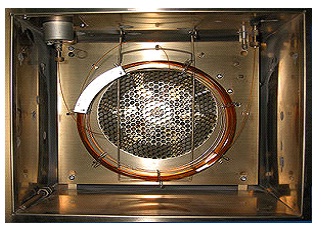
The oven is a special feature present in Gas Chromatography where absent in other chromatography systems. This basically fulfill two main requirements, first is that column is installed in the oven. Second is adjusting a suitable environment for the chromatogram development.  The column temperature must be uniform throughout the time period until the components are eluted out. Thus to maintain the temperature of the column the oven is an essential system in a GC.
    

Capillary Column in Gas Chromatography

    
Image
Liquidized stationary phases are used in capillary columns. Capillary column has a unique structure compared to the packed column . Capillary columns are also very tiny tube like structures which are highly coiled. The internal diameter of a capillary column is around 0.1-0.53 mm.  The liquid stationary phase is coated as a thin film on the solid adsorbent which has been inserted into the coiled tube. This column type is longer than the packed column. Thus capillary columns may take more time to separate the test sample. On the other hand capillary columns do not need a large space in the GC system. 
    

Packed Column in Gas Chromatography

    
Image
Liquidized stationary phases are used in packed columns. Packed columns are very tiny, erect, tube like structures. The internal diameter of a packed column is around 2-4 mm. The stationary phase is packed inside this tiny tube, thus calling this structure as packed column. The stationary phase can be a single solid adsorbent or liquid coated solid adsorbent. Packed columns are not long as capillary columns . Thus the path length for the separation is slightly lower than the capillary column. Hence we can guess the packed columns separate the test sample much quicker than the capillary column. On the other hand use of packed columns takes more space than the capillary columns.
    

Columns in Gas Chromatography

    
Image
The stationary phase is the non-movable phase in chromatographic techniques. The mobile phase together with the test sample is moved through the stationary phase. During this passage of the mobile gas and the test sample the components in the test sample is separated. The stationary phase is packed inside a column in most chromatographic techniques. In Gas Chromatography two types of columns are used. Those are namely, Packed column   Capillary column   Depending on the packed material the column differs.
    

Injection Port and Sample Injection in Gas Chromatography

    
Image
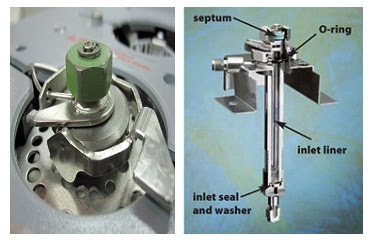
The test sample is usually carried with the mobile phase. Then the test sample is gone through the stationary phase together with the mobile phase. In GC the test sample is inserted into the system via an injection port.  Like in HPLC  the test samples are injected into the chromatographic procedure. Injection is done through a self-sealing rubber system. And the test sample is injected using a gas-tight syringe. The gas tight syringe allows only micro liter amounts to be inserted in into the GC when using liquids as the testing sample. Then this is carried by the mobile gas. Together with the test sample the mobile gas is gone into the column where the stationary phase is present.
    

Carrier Gas in Gas Chromatography

    
Image
Carrier gas supply Every chromatographic technique includes a mobile phase and a stationary phase. Mobile phase is interacted with the stationary phase in order to proceed the separation. Basically the mobile phase is gone through the mobile phase together with the test sample. Which means the test sample is carried by the mobile phase. In gas chromatography the mobile phase is a gas. Thus in GC the mobile phase or the mobile gas is termed as the carrier gas. The carrier gas should perform several characteristics. Carrier gas should be inert, dry and free from impurities. The testing sample is either a gas or a liquid in GC. This test sample is carried onto the stationary phase by the carrier gas or the mobile gas. If carrier gas is a very reactive one, then it will perform a reaction with the test sample. If carrier gas contains moisture then of course the water molecules will react with the test sample. And also the presence of impurities will also interact with the test gas ...
    

Parts of Gas Chromatography

    
Image
Gas Chromatography is another type of technology used in separation of gases. This is a complex set of sections joined together to form a single instrument, thus making much easier to separate, identify and quantify the gases of interest. Unlike other chromatographic techniques in GC there is no need of developing chromatograms and other difficult time consuming things! It only matters a scientist or a technician who is capable of handling the instrument as well as the handler should perform good knowledge in chromatography.   Gas chromatography consists with a carrier gas supply, an injection port, a column, an oven and a detector. The detector output will be received by an integrator which is an instrument that will integrate the output signal. And the integrated signal is then recorded from a recorder. 
    

Gas Chromatography (GC)

    
Image
Gas chromatography or GC is a type of adsorption chromatography. The mobile phase of gas chromatography is a gas. This is the reason why this is termed as “gas chromatography”. The stationary phase can be either a solid adsorbent or a liquid adsorbent. If it is a solid adsorbent then this is called as “gas-solid chromatography” where as if liquid adsorbent then this is called as “gas-liquid chromatography”. In gas-liquid chromatography a non-volatile liquid has to use. Gas chromatography helps in many ways to detect explosive air pollutants, essential oils and very useful forensic studies.  The following topics related to GC will be discussed in detail.  Parts of GC Carrier gas in Gas Chromatography Injection port and sample injection  in Gas Chromatograph y Columns in Gas Chromatography Capillary column in Gas Chromatography Packed column in Gas Chromatography The oven in Gas Chromatography Detectors in Gas Chromatography Flame Ionization detector ...