Posts

Showing posts with the label Paper Chromatography

Quantification of Compounds in Paper Chromatography

    
Image
The separated compounds on the chromatogram are first identified. Then the identified compounds are quantified according to the requirement. Quantification can be a comparative study among the separated compounds or it can be an accurate reading by a well performed instrument. Measuring the intensity of the colour under UV light is a comparative study to a certain extent. Another quantifying technique is done by cutting the chromatogram fragment where the separated compound of our interest is present. Then carrying out a chemical analysis of that piece of fragment. Measuring the radio activity using the Geiger Muller counter is a method used to quantify compounds in a highly accurate manner.
    

Two Dimensional Techniques in Paper Chromatography

    
Image
Two dimensional technique is another complex set up which is used to separate complex mixtures. In this method the development of the chromatogram is done as in the previous methods . Solvent is placed at the bottom of the tank and the filter paper saturated with the stationary phase is then kept inside the tank. The development occurs up wards. But very slowly because it is against the gravity as well as the compound is a complex one. After few hours the filter paper is turned 90 0 clockwise and the tank is filled with a different type of solvent. If there is no pronounced separation then development is proceeded to the “c” stage. Again the filter paper is turn 90 0 clockwise and used another solvent. This will probably end up with a satisfactory separation. If not again it should be turned and use another solvent. Although this will take some time, this allows a high degree of separation.
    

Paper Chromatography Descending Method

    
Image
The descending technique is a complex setup. This is built due to its time consuming ability. This develops along the gravity. Thus there is a force which will make the separation quick and easy. The filter paper is attached to a paper support. And the developing solvent (mobile phase) is filled into a chamber. The filter paper is saturated with the stationary phase before it is hung.  The mobile phase will gradually move downwards carrying the spot of the test sample along the paper. The term descending is given because the separation or the development of the chromatogram is taking place towards down . In this technique most polar substance will be on the top with respect to the tank where as the least polar ones will be at the bottom.
    

Paper Chromatography Ascending Method

    
Image
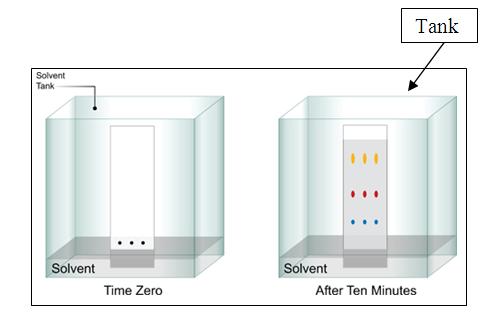
In ascending technique the chromatogram is attached in a way that the spot is touched with the solvent where the solvent is at the bottom. The development of the chromatogram or the separation of the spot is against the gravity. This is why this is termed as ascending technique. There is a paper support on the top of this tank. The mobile phase (solvent) is at the bottom of the tank. The filter paper is attached to the tank by the paper support and filter paper will touch the solvent. But the spot should not touch the solvent. The mobile phase will gradually rise up wards and carry the spot substances. The most polar substance will be at the bottom with respect to the tank where as the least polar will be on the top end of the tank. Ascending technique is relatively a slow process.
    

Methods of Development in Paper Chromatography

    
There are three methods of developing a paper chromatogram. This is to separate different substances according to their solubility abilities. Since different compounds have different characteristics the development technique of this particular type chromatogram differs in three formats. Those are as below, Ascendingmethod in paper chromatography Descendingmethod in paper chromatography Twodimensional techniques (2-D) in paper chromatography These are different by the way that the spot develop it into a chromatogram. In some cases the chromatogram develops against the gravity where as other it develops along the gravity. The detail explanation can be studied in the here .
    

Procedure of Paper Chromatography

    
Image
The spot of the test sample is loaded on the filter paper using a capillary tube. This spot should always be a concentrated but a very minute one. Capillary tubes are used in paper chromatography, because a small quantity can be taken into the tube without any force. The upper line (solvent front) is drawn on the paper from 2 cm on the top and the bottom line (base line) is drawn from 2 cm from the bottom of the paper. Usually 0.01g of the sample is dissolved in the running solvent (1g). Micro liter quantities are used to spot on the paper by a capillary tube. The diameter of the spot should be only up to few mili meters. The spotting should be done several times in order to get a concentrated spot. This filter paper is then placed inside the chamber saturated with the solvent to develop the chromatogram. The chromatogram is then heated in an oven to high temperatures. This can be done not only by an oven but also using a fan, air etc.
    

Paper Chromatography Separation Mechanisms

    
Image
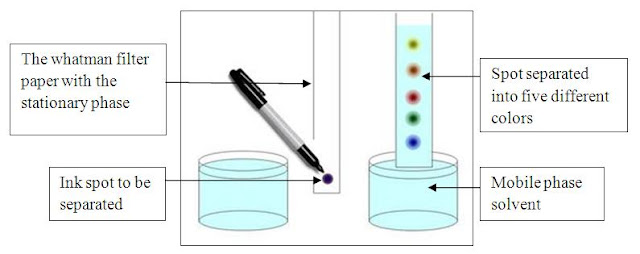
The mobile phase rises up by the capillary action. The testing sample is concentrated as a minute spot at the bottom of the filter paper. When the mobile phase which is a liquid, rises up in the filter paper the spotted mixture is gradually rises with the mobile phase. This eventually leads to the separation of the compounds. Compounds in the mixture will be separated according to their ability of the solubility. In other words it is again the polarity as in open column chromatography . More polar substances will move slower and less polar substances will travel faster. Consider “A” substance is more soluble than “B” in the stationary phase, thus “A” will dissolve in that solvent. This means “A” is more polar than “B” with respect to the stationary phase solvent. Thus “A” will travel slowly than “B”. And “B” will elute first. This explains that substances that having more solubility in stationary phase move slower and substances having less solubility in stationary phase move fast...
    

Paper Chromatography

    
Image
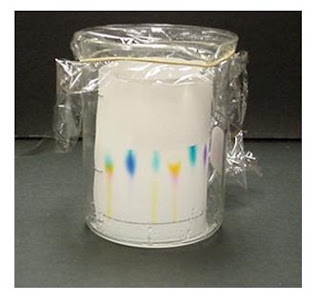
The mode of separation of paper chromatography is the partition and the basis for the separation is solubility. As in other chromatographic techniques this also has a stationary phase as well as a mobile phase. Both phases are liquids. Stationary phase is water that is tightly bound to the paper. Filter papers are used for this purpose and most common filter paper used is Whatman filter paper- 98-99% Alpha cellulose. The cellulose paper can well absorb water molecules. Fiber of cellulose acts as the stationary phase. Mobile phase is a solvent- solvent partially miscible in water. Paper chromatography is usually used for separating amino acids and anions and also testing histamines and antibiotics. Paper chromatography will be discussed as in the following. Mechanism of separation in paper chromatography Procedureof paper chromatography Methodsof development in paper chromatography RFvalue in chromatography Spotlocation in chromatography Quantificationof compounds in pap...